The Closing of America
The Economic Consequences of Immigration and Trade Restrictions
Immigration: Effect on Native Population Wages and Economic Growth
Example of Crime Research
Is there a relationship between immigration and crime?
Negative relationship between crime and immigration
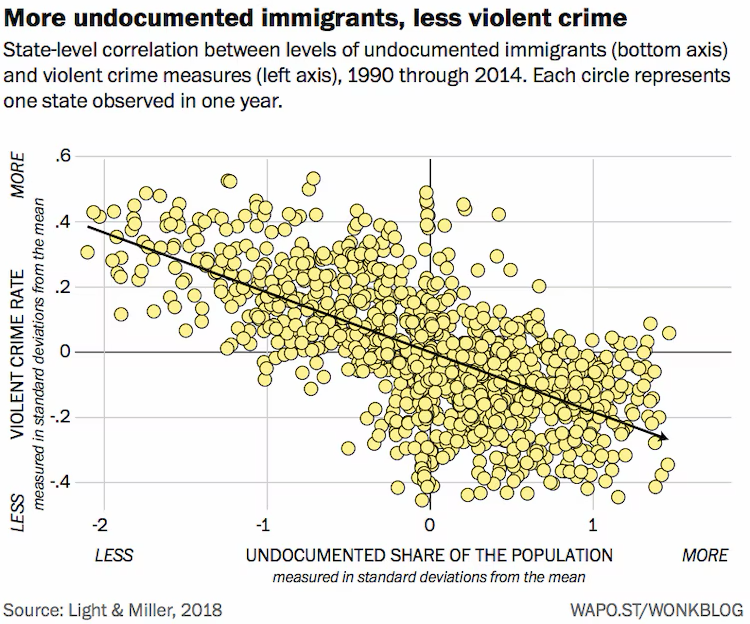
There is a negative relationship between crime and immigration.
- But is it Causal?
- It is likely that immigrants are aware of crime and move to places with low crime.
- To study causal impact, ideally we would have an RCT — a random shock of immigrants to cities.
Solving the Causality Problem
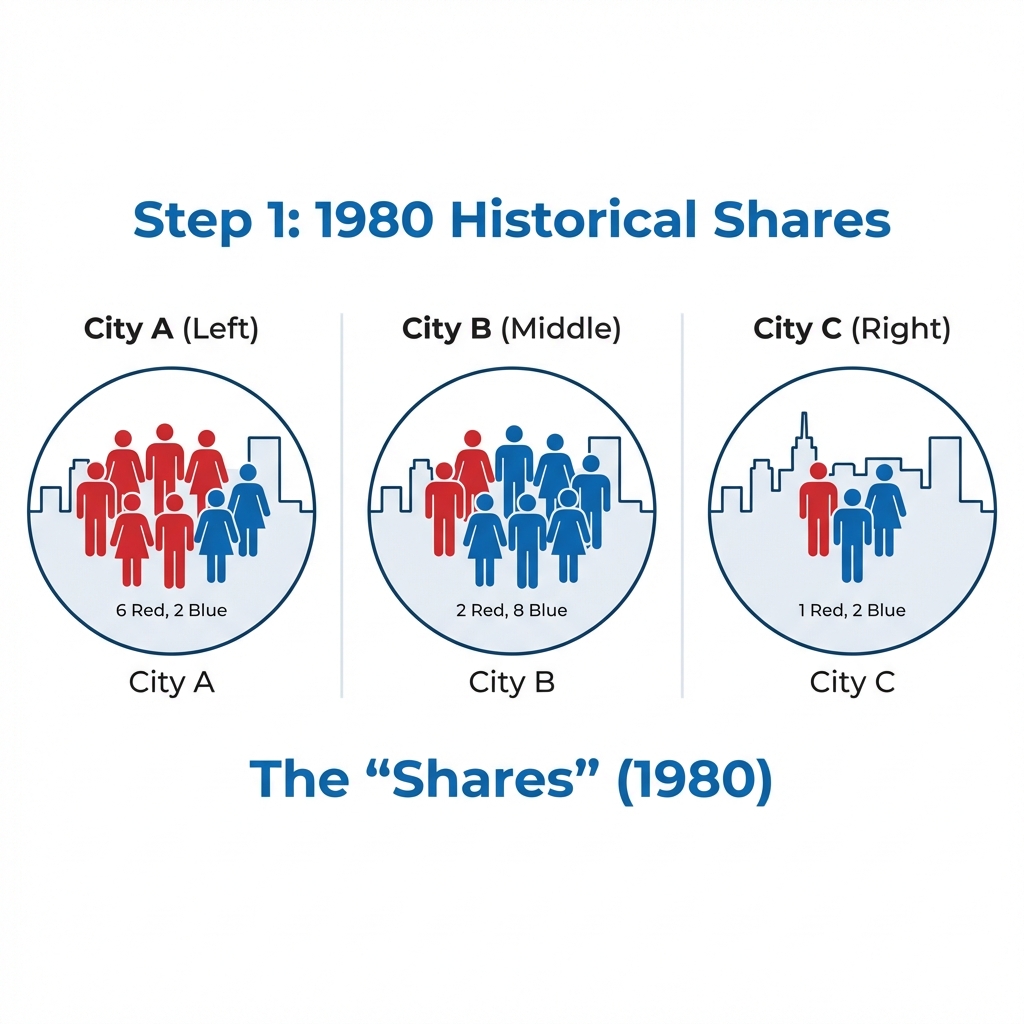
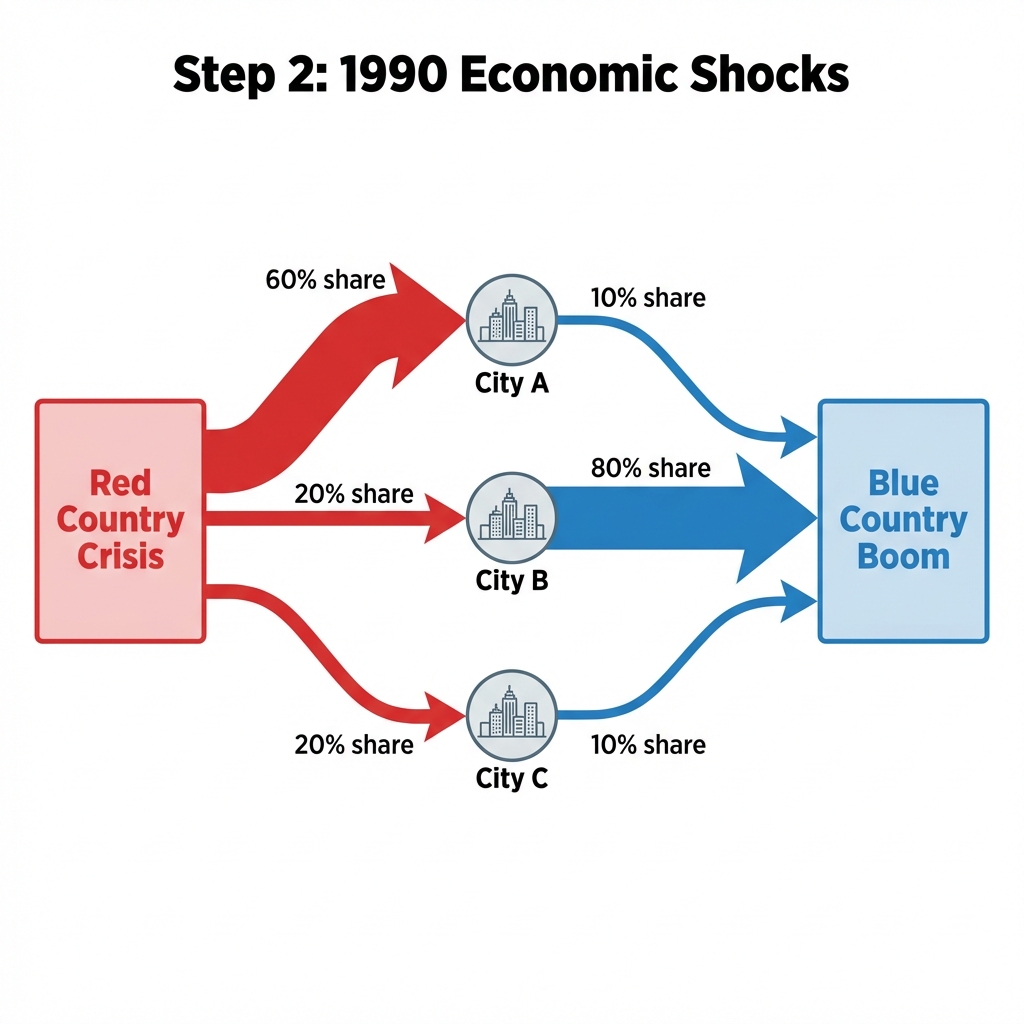
- Shift-Share Instruments:
- Uses historical settlement patterns to predict current immigration.
- If immigrants go to existing enclaves based on historical ties, this is a "lagged" effect, unassociated with current crime fluctuations.
What the Research Finds: Immigration and Crime
| Paper | How They Isolated Cause | Violent Crime | Property Crime |
|---|---|---|---|
| Butcher & Piehl (1998) | Where immigrants settled historically | No effect | No effect |
| Spenkuch (2014) | Historical immigrant settlement patterns | No effect | Positive in OLS, not significant in IV |
| Chalfin (2014) | Droughts in Mexico push emigration | No effect | No effect |
| Chalfin (2015) | Mexico birth rates predict who migrates | Mixed ↑ Aggravated Assault ↓ Rape |
Decrease |
The Mariel Boatlift
The Effect on Wages
- Common concern: Immigrants increase labor supply, thus driving down wages for native-born workers.
- How do we test this causally without confounding factors?
- We need a Natural Experiment.
The Mariel Boatlift (1980)
- April–October 1980: ~125,000 Cuban immigrants arrived in Miami.
- Increased Miami's labor force by 7% in a few months.
- Predominantly low-skilled workers.
- Why this is useful: It was a sudden, localized shock driven by foreign political factors, not by Miami's booming economy.
The Findings
- David Card (1990): Found essentially no significant effect on wages or unemployment for native workers, even for low-skilled demographics. Miami's labor market absorbed the influx rapidly.
- The Debate (George Borjas 2017): Argued that if you narrowly zoom in on the sub-demographic of high-school dropouts, there was a negative short-run impact — a 3 to 4 percent wage drop for that specific group.
More Broadly
- Borjas used the historical patterns of immigration to predict immigration in different cities and their impact on wages.
- His paper is estimating the short-run impact.
"The assumption of a constant capital stock implies that the resulting wage consequences should be interpreted as short-run impacts. Over time… changes in factor prices will fuel adjustments in the capital stock that attenuate the wage effects."
Borjas: Short Run Effect
- Borjas finds a 10% increase in labor supply for a given education level decreases wages in that group by 3–4%.
- In the long run, businesses invest, capital expands, and the economy grows to match the larger population.
The Long Run
- Once capital has expanded to absorb the larger workforce, the long-run wage impact depends on a key question: is immigrant labor a complement or a substitute to native labor?
- If substitute: immigrants and native workers compete for the same jobs — wages for natives are permanently lower.
- If complement: immigrants and native workers do different tasks, each making the other more productive — wages for natives rise.
- Let's look at the evidence.
Findings on Restrictions
The Chinese Exclusion Act — Methods
- Question: Did removing Chinese workers actually help white workers — or hurt everyone?
- The 1882 Chinese Exclusion Act hit different counties very differently depending on how many Chinese workers lived there before the ban.
- The research strategy: Compare counties with many Chinese workers before 1882 to counties with few — before and after the Act. The timing of a federal law is not driven by any one county's economic conditions, making this a clean natural experiment.
- As a check, they ran the same analysis on eastern states (where few Chinese lived) — and found nothing. This "placebo" test confirms the results are real.
The Chinese Exclusion Act — Findings
- Removing Chinese workers did not help white workers — it hurt them too.
- White workers did not take the jobs Chinese workers left. The businesses that relied on Chinese labor grew much more slowly — and native workers' job prospects declined alongside them.
- The Act slowed economic growth across the 8 western states for at least 60 years.
Gifts of the Immigrants, Woes of the Natives — Methods
- Question: Did immigrants in the early 1900s actually cause economic and political change, or did they just happen to move to places that were already changing?
- The Immigration Acts of 1921 and 1924 imposed strict country-by-country quotas, sharply cutting immigration from some places but not others — for political reasons unrelated to any particular city's conditions.
- Combined with the fact that immigrants follow earlier waves of their own nationality to specific cities, this lets researchers predict which cities received more or fewer immigrants for reasons outside local economic trends.
- Study covers 180 US cities from 1910 to 1930.
Gifts of the Immigrants, Woes of the Natives — Findings
- Economically: For every 10 immigrants who arrived, 2 additional native workers found employment. Native workers also moved into better-paying occupations and manufacturing output rose.
- Politically: Despite those gains, the same cities elected more conservative politicians, cut public spending (especially on education), and their representatives were more likely to vote for further immigration restrictions.
- The backlash was not driven by economic competition — it was driven by cultural and religious differences between immigrants and native-born residents.
- Immigration was good for people's wallets and bad for political tolerance — at the same time.
The Bracero Exclusion — Methods
- Question: If we kick out half a million foreign farm workers, do American farm workers get better pay and more jobs?
- In 1965, the US government abruptly ended the Bracero Program — removing nearly 500,000 Mexican seasonal farm workers in one stroke.
- The research strategy: Some states had many bracero workers before the ban; others had almost none. This geographic variation — driven by where braceros historically worked, not by current labor conditions — lets researchers compare what happened in heavily exposed states vs. lightly exposed ones.
- Researchers used original government archives to build the first complete map of where braceros worked, state by state.
The Bracero Exclusion — Findings
- Removing the braceros did not raise wages or employment for American farm workers — even in states that lost the most workers.
- Instead, farms responded in two ways:
- Mechanized: They bought machines to replace the hand-labor that braceros had done.
- Changed crops: They switched to crops that required less labor.
- The jobs did not transfer to American workers — they simply disappeared.
- Restricting immigration to protect workers can backfire when businesses adapt in ways that eliminate the jobs entirely.
The H-2B Lottery — Methods
- Question: What happens to a business when it gets — or doesn't get — low-skill immigrant workers?
- The US caps the number of H-2B visas (seasonal, non-agricultural low-skill workers) each year. When applications exceed the cap, the government runs a literal lottery to decide which businesses win visas.
- This lottery is as close to a randomized experiment as economics gets: winning or losing is purely by chance, not because of anything special about the firm.
- The researchers surveyed firms that entered the lottery in 2021 and 2022, comparing lottery winners to losers.
The H-2B Lottery — Findings
- Firms that won the lottery and received immigrant workers significantly increased production, investment, and profits.
- Firms that lost the lottery — and had to operate without those workers — produced less and earned less.
- Crucially: winning the lottery did not push out American workers. Native employment was unchanged or slightly higher at winning firms, particularly in rural areas.
- These immigrant workers and American workers were doing different tasks — they complemented each other rather than competing.
Immigration, Innovation, and Growth — Methods
- Question: Does immigration actually cause more innovation, or do immigrants just happen to move to already-innovative places?
- Immigrants cluster near earlier waves of their own nationality. Using 130 years of migration records, researchers build a prediction of which counties should receive immigrants from which countries — based purely on deep historical patterns, not on what's happening economically today.
- They then combine that predicted ancestry mix with recent national flows from each country (e.g. more people leaving India overall) to predict immigration into each county.
- Because the prediction is based on century-old settlement patterns rather than current conditions, any relationship with innovation is likely causal.
Immigration, Innovation, and Growth — Findings
- Immigration causally increases innovation: more immigrants in a county means more patents filed by local companies.
- It also raises wages for native-born workers — not just immigrants.
- Using a structural model, the authors estimate that if immigration had stopped after 1965, there would have been roughly 8% less innovation and 5% lower wages for American workers today — though these figures depend on model assumptions.
Effect on Prices
- Immigration increases demand for goods and services — but it also expands the workforce that produces them. In most markets, the supply-side expansion keeps pace, and prices are broadly unaffected or fall.
- Housing is different. The supply of housing cannot expand as quickly as the population — construction takes time, land is constrained, and zoning restricts new building.
- This raises an important question: does immigration drive up housing prices by adding demand that supply cannot quickly meet?
Cracking Down, Pricing Up — Methods
- Question: What happens to housing construction and home prices when immigration enforcement removes undocumented construction workers?
- The federal Secure Communities program rolled out county by county between 2008 and 2013, eventually deporting over 300,000 undocumented immigrants.
- Because the rollout was staggered across counties at different times — not driven by local housing conditions — researchers can compare counties before and after enforcement arrived, isolating the causal effect on construction labor and housing.
- Construction is one of the largest employers of undocumented workers, making this a direct test of what deportation does to housing supply.
Cracking Down, Pricing Up — Findings
- Deportations reduced the construction workforce — and domestic workers did not fill the gap. Native-born construction workers also lost jobs and hours.
- Any short-term price drop from fewer residents demanding housing was brief — within two years, supply-side price increases dominated everywhere.
- Deportations made the housing crisis worse, not better.
The NAS Approach to Fiscal Impact
- In 2016, the National Academies of Sciences was commissioned to produce a comprehensive estimate of the fiscal impact of immigration on the federal government.
- They counted what immigrants pay in taxes minus what they use in services.
- Overall finding: The average immigrant reduces the deficit — a net fiscal positive.
- But: Low-education immigrants appear to be a net fiscal cost of −$109,000 in present value over their lifetime.
- What the NAS accounting omits: when a firm hires an immigrant worker, it also invests in more capital — and the profits from that capital generate tax revenue. None of that is credited to the immigrant.
The Fiscal Effect: Adding the Missing Tax
- Clemens adds one correction: include the taxes paid on capital profits that immigrant labor makes possible.
- This flips the result for low-education immigrants — from a cost to a benefit:
- The overall average immigrant's positive fiscal impact is 3.2× larger once capital taxes are included.
The Immigration Surge and the Federal Budget
- The Congressional Budget Office estimated the 2021–2026 immigration surge will reduce federal deficits by $900 billion over the next decade (2024–2034).
- $1.2 trillion in additional federal revenue (income and payroll taxes).
- $0.3 trillion in additional federal outlays (mandatory programs and interest).
- Net effect: immigration surge improves the fiscal outlook.
The Gains to Immigrants Are Enormous
Immigrants come here because America is a great country — a place of extraordinary opportunity. Coming here makes their lives dramatically better.
The gains to the immigrant vastly exceed any cost or benefit to us. Deportation doesn't just hurt our economy — it takes away a life-changing opportunity from people who came here because America works.
Conclusion: Immigration
The Case of Tariffs
A Personal Note on Tariffs
- I came to economics through activism — specifically the Jubilee 2000 campaign, which fought to cancel the debts of the poorest countries.
- Part of that fight was opposing the IMF's practice of forcing developing countries to drop their tariffs as a condition of receiving loans — what economists call "structural adjustment."
- So I need to be clear: I am not against tariffs in principle. They can be a legitimate tool of economic policy.
- What I am against is the specific way the Trump tariffs are being used — for reasons I'll explain.
Why Do Countries Use Tariffs?
- Industrial Policy — Protecting and encouraging specific domestic industries.
- Revenue — Generating income for the government.
- Negotiations — Using tariffs as leverage in trade deals.
Why Do Countries Use Tariffs?
- Industrial Policy — Protecting and encouraging specific domestic industries.
- Revenue — Generating income for the government.
- Negotiations — Using tariffs as leverage in trade deals.
Comparative Advantage
- Since David Ricardo, we have known that every country gains from trade if each specializes in what it produces most efficiently relative to others — its comparative advantage.
- Free trade produces these static efficiency gains. This is not seriously disputed.
- But countries may not want to stay where their comparative advantage currently lies.
- A developing country with a comparative advantage in agriculture and resource extraction faces a problem: those sectors tend to offer low wages, limited technology spillovers, and little long-run growth.
- They may want to change their comparative advantage — to move into industry, manufacturing, and technology. That takes time and protection while domestic industries develop.
Industrial Development
- Developing countries often can't compete with established foreign industries on day one — costs are higher, productivity is lower, and the technology gap is real.
- A targeted tariff can give a domestic industry time to grow, learn, and become competitive — what economists call the infant industry argument.
- This is how South Korea, Taiwan, and Japan built their industrial bases. It's also how the early United States protected its own manufacturing from British competition.
- The IMF forcing poor countries to drop these protections prematurely — before their industries could develop — is what many economists and activists criticized.
Industrial Development — Does It Apply to the US?
- For a developed economy like the US, the infant industry argument largely doesn't apply — we already have mature, competitive industries.
- When the US wants to enter a new high-tech field — like semiconductors — subsidies are generally a better tool than tariffs.
- Why? Tariffs protect by raising the cost of the imported good. But every downstream industry that uses that good — car makers, construction firms, appliance manufacturers — pays more too.
- A tariff on steel protects steelmakers. It taxes everyone who buys steel.
Impact of Tariff Reductions on GDP per Capita
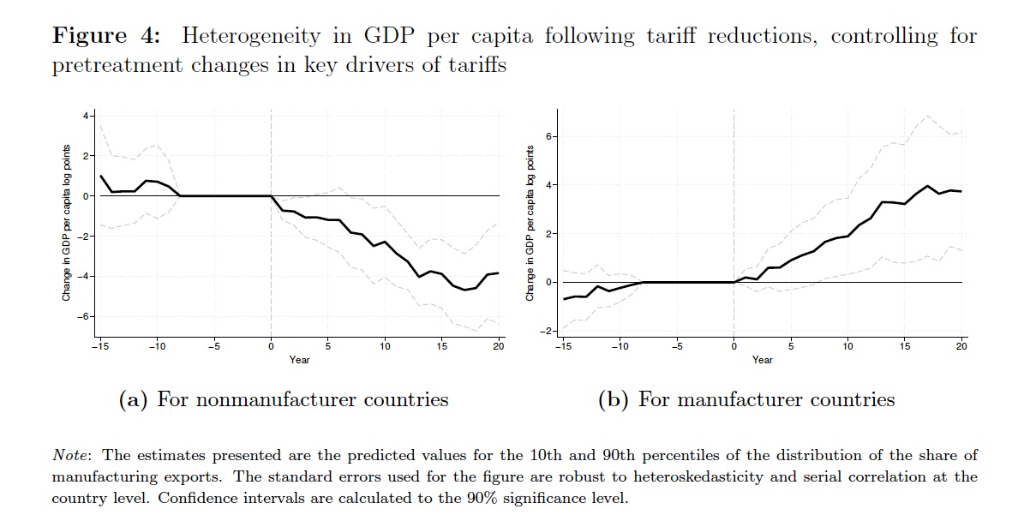
Manufacturing countries (right) benefit from free trade. Non-manufacturing countries (left) may see negative impacts — suggesting a role for protection in early development.
Case Study: Steel Tariffs (2018)
The Policy: 25% Tariff on Imported Steel
Tariffs for Industrial Policy Must Be Carefully Targeted
- You need a specific reason you can develop a comparative advantage — economies of scale, learning-by-doing, spillovers — not just a desire to have the industry.
- Must target final goods, not inputs that raise costs across the whole economy.
- Time-limited — long enough for firms to invest, but with a sunset. Permanent protection breeds complacency.
The Cost of Misplaced Tariffs
- Every misplaced tariff forces us to dedicate economic resources — workers, capital, land — to producing something we could import cheaply.
- Those resources are no longer available for the things we actually do well.
- This is not just inefficiency. It is a real reduction in living standards — less of everything, for everyone.
Petition of the Candlemakers — Frédéric Bastiat, 1845
"We are suffering from the ruinous competition of a foreign rival who apparently works under conditions so far superior to our own for the production of light that he is flooding the domestic market with it at an incredibly low price... This rival is none other than the sun."
A satirical argument for tariffs on sunlight to protect candle-makers from unfair foreign competition.
Bastiat's point: protecting an industry from cheaper competition always sounds reasonable to the industry being protected. The costs fall on everyone else.
Why Do Countries Use Tariffs?
- Industrial Policy — Protecting and encouraging specific domestic industries.
- Revenue — Generating income for the government.
- Negotiations — Using tariffs as leverage in trade deals.
Tariffs for Revenue: Not Free Money
- Tariffs are paid by domestic buyers — importers, manufacturers, consumers. Studies find >95% of the cost falls on Americans, not foreign exporters.
- To judge tariffs as a revenue source, we need to ask: how efficient is this compared to other taxes? Which taxes do the least damage to economic growth?
- The goal is to raise revenue while minimizing the drag on GDP.
How Efficient Taxes Work
- Damage rises with the square of the rate — a 10% tariff is four times more damaging than a 5% one.
- For revenue: you want a wide base, low rates.
- Income taxes: broad base, modest behavioral distortion — efficient. Tariffs: narrow base (trade), high rates, large distortions.
Tariffs Are Uniquely Distortionary
- Most taxes create one distortion. Tariffs create two: they change what consumers buy and what domestic producers make.
- Two wedges, two sources of waste — making tariffs roughly twice as distortionary as a tax raising the same revenue.
Tariffs: Gains from Trade & Deadweight Loss
Why I Opposed the IMF — And Why Trump Tariffs Are Different
- Developing countries: trade can be 80% of GDP, with no functioning income tax. Port tariffs are often the only practical revenue source — the IMF demanding they drop them was premature.
- The US is different: trade is only ~14% of GDP, we have a broad income tax base, and Trump's rates are so high the DWL dwarfs the revenue raised.
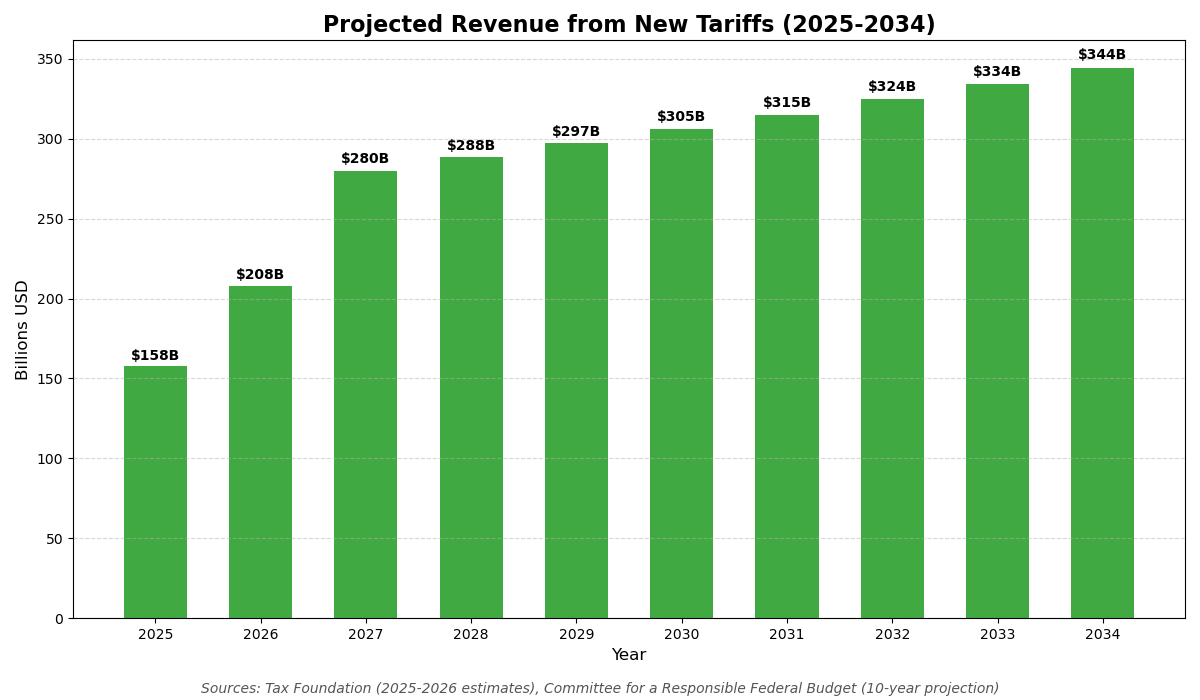
Projected Tariff Revenue (2025–2034)
Projected GDP Impact
- Yale Budget Lab: 1.1% reduction in real GDP growth for 2025.
- Tax Foundation: Long-run GDP reduction of 0.8% (accounting for retaliation).
- OECD: US growth slowing from 2.8% to 1.6% in 2025.
- Penn Wharton Budget Model: Long-run cumulative GDP reduction of 6–8%.
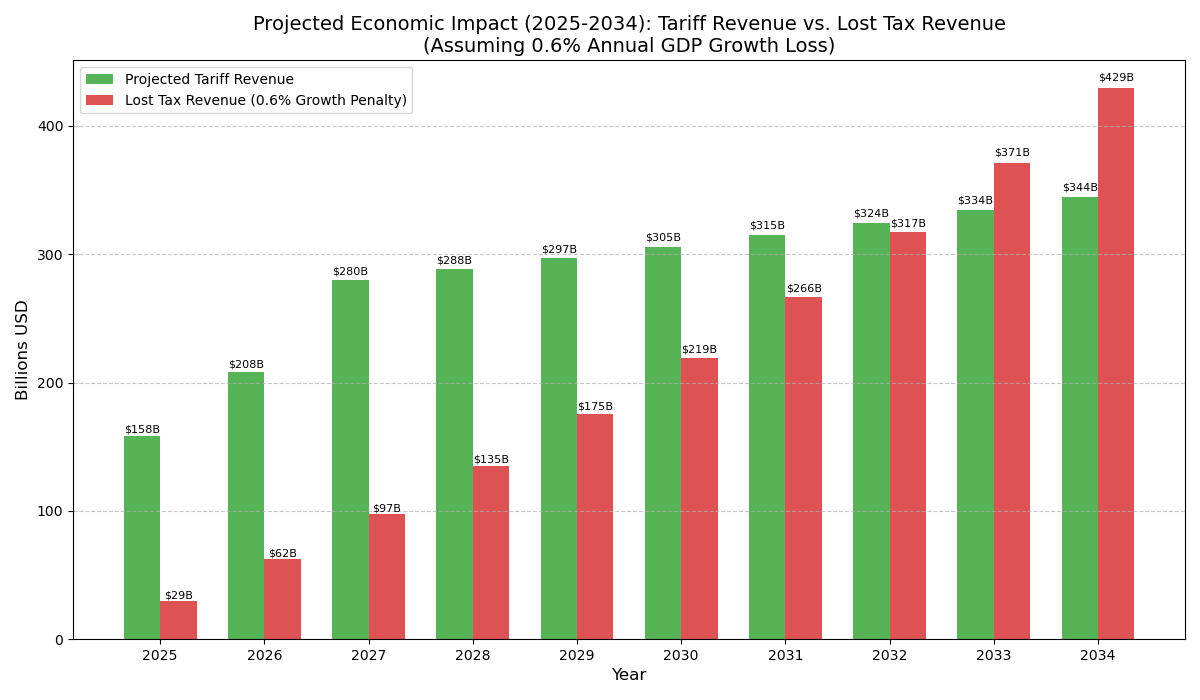
The Cost of Tariffs: Revenue vs. Lost Growth
Why Do Countries Use Tariffs?
- Industrial Policy — Protecting and encouraging specific domestic industries.
- Revenue — Generating income for the government.
- Negotiations — Using tariffs as leverage in trade deals.
Tariffs as Negotiation
- We have seen how tariffs can harm the country implementing them. They do even more damage to the foreign countries whose exports they hit.
- This is a negative feature of tariffs — but it is also what gives them leverage. Each country wants to keep its own tariffs as a bargaining chip to get others to drop theirs.
- The result is that countries can negotiate mutual reductions: "I'll lower mine if you lower yours." This is the logic behind the WTO and most trade agreements.
- This is precisely why I objected to IMF structural adjustment programs forcing developing countries to unilaterally drop their tariffs — they gave up their negotiating position and got nothing in return.
Tariffs as Negotiation: The Problem
"You are pulling out a grenade and threatening to hurt both of us at the same time."
- Using tariffs as leverage only works if the threat is credible — and if you're willing to follow through even when it hurts you.
- The more economically damaging your tariffs are at home, the less credible your threat becomes. Trading partners can simply wait you out.
- Current US policy appears aimed primarily at negotiation — but with rates so high and applied so broadly that they are causing serious domestic damage before any deals are struck.
World Reaction to Liberation Day Tariffs
- Many countries did not panic. Three reasons why:
TACO
Trump Always Chickens Out. Based on his record, trading partners calculated he would back down before causing serious damage — and largely waited him out.
The System
The US political and legal system would constrain him. The Supreme Court largely did — striking down or limiting the legal basis for the most sweeping tariffs.
Give Him a Win
Just give Trump something to brag about. A symbolic concession, a photo op, a repackaged existing commitment — and the tariffs come down.
The Trade Deficit Contradiction
- Liberation Day tariffs were justified as necessary to eliminate the US trade deficit.
- At the same time, Trump has repeatedly bragged about securing commitments of foreign investment in the United States.
- Countries have learned to simply repackage existing plans, pre-announced investments, or business-as-usual activity — and present it as a new commitment secured by Trump's tariff pressure.
- Trump declares victory. Tariffs come down. Nothing actually changed.